Perception & Awareness
Careful observation, recall, situation monitoring and the separation of facts from inference.
Two disciplines.
Independent judgment.

Personal assessment & team readiness

Exercises, studies & reference material
An emerging boutique COGSEC consultancy operating at the intersection of private intelligence, applied psychology, and human performance.
Cognitive security (COGSEC) concerns the protection of judgment and decision-making from manipulation.
Field / Assessment & training
Examine how you judge. Strengthen how you respond.
Guided training in observation, composure, and judgment. Work through structured scenarios, review your decisions, and receive an individual development report.
Personal instruction.
Deliberate practice.
Specific feedback.
A facilitated engagement
A baseline review, six Labyrinth modules, two private sessions (orientation and debrief), and one final Threshold assessment form your individual program.
Your deliverable
Recorded observations, clear development priorities, and practical next steps. The report describes performance within the agreed tasks.
Enquire about the complete $350 USD program. Suitability, scheduling, and terms are agreed before payment.
One-time program fee: $350 USD. Includes baseline review, six training modules, two private sessions, one Threshold assessment attempt, an individual report, and a 30-day development plan. Online checkout is not yet available. The client area remains locked until payment is verified. An enquiry does not take payment or reserve a place.
Private client access
Sign in to your client area. Assessment access requires a verified payment for The Operative Standard.
Explore six introductory chambers, each with two decisions and explanatory feedback. These free exercises introduce the methods; they do not count toward the paid Threshold assessment.
Public practice is free. The Threshold assessment is reserved for accepted, paid participants. Online checkout is not yet available; signing in alone does not unlock the assessment.
Explore six areas of judgment through short scenarios and explanatory feedback.
Careful observation, recall, situation monitoring and the separation of facts from inference.
Self-regulation, attention control and adapting judgment when information changes.
Professional communication, boundaries, negotiation and interpersonal judgment.
Decisions about recovery, workload, and personal limits. Online scenarios do not measure physical fitness.
Disinformation, persuasive framing, manipulation and source verification.
Evidence evaluation, uncertainty calibration, ethical decisions and concise reporting.
Choose one of six short chambers. Make two decisions, then review the reasoning behind each response.
Review an incomplete briefing. Separate visible evidence from interpretation; report only what the record can support.
OBSERVED / RECALL ACCURACY AND INFERENCE CONTROLPractice feedback is educational and does not establish general ability or professional readiness.
Military & defense / Institutional training
A shared standard for clearer team decisions.
Scenario-based training for teams working with conflicting information, changing priorities, and time pressure. One framework, adapted to the organization’s roles and training objectives.
Pricing: TBD · Confirmed after scope review.
The engagement
Evaluate sources, recognize manipulative framing, communicate uncertainty, challenge assumptions, and coordinate decisions as evidence changes.
A training lead, participant numbers and roles, priority learning objectives, preferred format and timing, and agreed information-handling requirements. Use unclassified, non-sensitive examples.
Participant numbers, session length, delivery format, and reporting access are agreed before commissioning. Evaluation addresses observable behaviors within the exercises; it does not certify operational readiness.
This is an organizational engagement, separate from the $350 individual Operative Standard. Final scope and pricing remain TBD until agreed in writing.
“The mind is both an instrument of influence and a domain of conflict—a battleground where perception is shaped, judgment is contested, and autonomy must be defended.”
Research / Perception & judgment
Investigating perception. Practicing judgment. Examining the evidence.
Experimental studies
Two exploratory studies in anomalous perception. Examine the methods, review the recorded results, or try a practice session. Participation is separate from the paid Field program.
Precognition data
A four-symbol task: predictions are recorded before the target is selected.
Loading the recorded series…
Remote viewing data
An image-comparison task: impressions are locked before candidate images appear. General and Focused formats remain separate.
Loading the recorded series…
An investigation into concentration, mental distraction, recovery, and the efficient use of attention.
When attention drifts, the mind spends effort returning to what matters. Stillpoint studies whether deliberate awareness and relaxation practices can improve the quality of that return.
“Brain bandwidth” is a metaphor—not a measured increase in neural throughput. More effective attentional regulation may help a person use existing cognitive resources with less distraction. Whether this translates to broader performance gains must be tested.
Short, voluntary exercises with a private self-observation log. Not a clinical or psychometric examination.
Practice maintaining and restoring a chosen focus.
Eyes open or closed, as comfortable. Maintain normal breathing. Stop if you feel distressed or unwell; these exercises are optional and do not replace medical or mental-health care.
Rate your perceived ability to settle attention before and after. These are subjective reflections, not measures of intelligence or brain capacity.
No entries recorded on this device.
Entries remain in this browser's local storage only. They are not sent to ONLI or ChatGPT. Clearing browser data removes them.
Distinguish plausible mechanisms and research findings from stronger claims about performance.
A 2024 meta-analysis of 111 randomized trials found small-to-moderate improvements in several cognitive accuracy measures, including sustained attention and working-memory accuracy. Processing speed and several other measures did not improve.
Review study ↗A review of digital mindfulness programs found encouraging results for attention control, but null results were at least as frequent as positive results across included studies. Training format matters.
Review study ↗Meditation may help with stress and sleep quality. Evidence also links voluntary slow breathing with changes in heart-rate variability; neither finding establishes an increase in brain processing capacity.
Review evidence ↗Research standard. Stillpoint provides timed practice and stores optional self-reports; it does not measure brain bandwidth, diagnose attention conditions, or certify enhancement. To test meaningful transfer, ONLI would need controlled comparisons using validated performance tasks.
Methods, references, and historical records.
Responses are recorded before feedback, evaluated against the stated baseline, and retained with misses and unfinished sessions. These exercises do not establish operational psychic capability. Each lab and report states its procedure and interpretive limits.
Cassandra / Precognition lab
A four-option target exercise with a 25% chance baseline.
Choose a symbol → Submit your prediction → Review the outcome
Practice runs stay in this browser session and do not enter the recorded ledger.
Preparing session reference…
Recorded trials are maintained by the ONLI record owner.
How the record works
The ledger measures performance on this specific task. It does not by itself establish psychic ability or intelligence reliability.
Targets are selected uniformly from four options after submission. A SHA-256 commitment is published before feedback; the target and random salt are released at reveal so the commitment can be checked. All accepted recorded trials remain in the history. Practice runs are excluded.
This is an ONLI-operated record, not an independent audit. This series feeds Cassandra’s observed report.
Loading the recorded ledger…
| Trial / Recorded | Prediction | Target | Outcome | Record |
|---|
General & Focused / Version 04
The target is selected before you record. Impressions lock before comparison and feedback.
Choose a format → Record impressions → Compare images → Review the outcome
Practice stays in this browser and is excluded from the dossier.
Target reference
Begin to receive your target reference.
Your impressions are locked. Select one candidate before target feedback. This is participant self-matching, not independent judging.
Recorded sessions are maintained by the ONLI record owner.
Method and limits
Self-matching does not establish remote-viewing ability.
The target already exists before the response. This differs from Cassandra, where target selection follows the prediction.
General mixes locations, animals, and objects. Focused uses one theme chosen before the reference is generated. Each session fixes four distinct images and their order before impressions; the exact previous set is not repeated. Images are randomly drawn from a finite generated catalog and may recur later. Each test format is reported separately. The exact-match comparison baseline is 25%; practice is excluded.
Loading recorded sessions…
General and each Focused theme are tracked separately. Earlier protocols remain identified in the full report.
A shared vocabulary makes a question easier to examine.
An impression is an original response. A match is a result under a stated scoring rule. An intelligence assessment requires corroborating evidence, context, and a clear account of uncertainty.
Record what appeared before explaining what it means.
Separate sensory descriptions such as curved, cool, or moving from object labels such as bridge or river. A label can introduce details that were not present in the initial response.
Write or sketch before viewing candidates. Preserve uncertain, conflicting, and empty responses rather than improving them after feedback.
Note prior knowledge, recurring images, emotional associations, and anything seen before the session. Consider how those influences might explain a response.
If an interpretation changes, append it with a time and reason. Compare the original record with the final account to see which details were added later.
Heuer’s 1999 reference discusses perception, memory, mental models, and hindsight in intelligence analysis. It is an analytic reference, not evidence for anomalous perception.
Sources & further reading
ONLI’s guide is separate from the linked authors’ work. Links checked 24 October 2026.
Identify the claim, the intended response, and the evidence.
Describe how the issue is presented. Note loaded labels, omitted alternatives, and assumptions that the wording asks you to accept.
Find the original evidence. Several outlets repeating one account do not provide several independent confirmations.
Notice repetition, urgency, emotional intensity, and appeals to authority. Ask which action the message is encouraging and whether its evidence supports that action.
Restate the claim in neutral language, consider a competing interpretation, and identify evidence that would change the assessment.
Paul and Matthews’s 2016 RAND analysis examines a propaganda model using many channels, rapid repetition, and inconsistent claims. It provides a specific case for studying influence, not a universal explanation for every persuasive message.
Sources & further reading
ONLI’s guide is separate from the linked authors’ work. Links checked 24 October 2026.
Work through three authored communications. Recognize pressure, choose an independent check and respond proportionately. Misleading wording alone does not establish intent, coordination or an organized campaign.
Begin Cognitive Resilience ↗Fix the conditions. Preserve the first response.
Choose the protocol, target pool, and scoring rule before beginning. Specify whether the target exists before the response or is selected afterward.
Withhold the target and identifying cues. Record what the participant and facilitator know. Consent and agreed boundaries apply when other people are involved.
Note forms, textures, movement, scale, and spatial relationships. Keep direct impressions separate from guesses or explanations.
Keep the original wording and time. Add later comments as dated additions rather than rewriting the response.
Preserve the target, comparison, score, and any deviation. Keep misses and unfinished sessions alongside matches.
The labs record their procedures and limitations. Browser practice is excluded from the observed dossiers; recorded sessions enter their corresponding study history.
A compelling match is a starting point for review.
Count accepted starts, resolved outcomes, misses, and unfinished sessions. A selection of memorable successes cannot describe overall performance.
The current four-option labs use a 25% exact-match comparison baseline. General, each Focused theme, and earlier protocols remain separate in Obscura’s report.
Check timing, information access, target selection, and the scoring rule. Participant self-matching and independent blind judging are different procedures.
Small samples can vary widely. An interval describes uncertainty under its stated model; it does not explain a mechanism. Changing a stopping rule or selecting favorable subsets changes the question being tested.
A laboratory score does not establish dependable intelligence. Operational claims require specific, independently corroborated information and evaluation under the conditions of intended use.
The historical 1995 evaluation addresses the difference between laboratory findings and practical intelligence use.
Control ordinary information before interpreting an unusual result.
List who knows the target, the candidate set, the scoring rule, and the participant’s response at each stage. State exactly who is blind to what.
Keep target selection, facilitation, and judging distinct where practical. A facilitator who knows the answer can introduce cues without intending to.
Review filenames, screens, messages, audio, timing, object placement, and feedback. A neutral reference identifies a session; it does not encode target information.
Fix the target set before impressions, lock the response before comparison, and release feedback only after scoring. Record any accidental disclosure alongside the outcome.
The website uses a finite, publicly available image catalog. Hiding the selected candidates until impressions lock controls one part of this limited task; it does not make the entire catalog unknown or constitute independent judging.
Sources & further reading
ONLI’s guide is separate from the linked authors’ work. Links checked 24 October 2026.
Choose the scoring rule before seeing the response.
One fixed choice is compared with one target. In ONLI’s four-option tasks, an exact match is a hit and every other selection is a miss. The comparison baseline is 25% under the stated random-selection model.
A written impression may contain many features. Define which features count, how they are weighted, and how ambiguous or contradictory details will be treated before feedback.
A judge compares the response with candidates without knowing which is the target. Preserve the original candidate order and rankings. Multiple judges need an agreed scoring procedure and a way to report disagreement.
The participant chooses the closest candidate after recording impressions. This is the current Obscura task. It should remain labeled separately from independent judging.
Sources & further reading
ONLI’s guide is separate from the linked authors’ work. Links checked 24 October 2026.
Make the prediction specific enough to be wrong.
State one observable outcome, its time window, the authoritative resolution source, and the rule for a correct prediction.
Preserve the exact wording and timestamp before the target is selected or the event resolves. A later interpretation must not replace the original.
Decide how postponements, cancellations, ambiguous outcomes, missing evidence, and multiple predictions will be handled.
Apply the same rule to every accepted prediction. Retain misses and unresolved entries, then append the outcome and supporting evidence.
Cassandra selects a four-symbol target after the prediction is submitted. Obscura selects its target before impressions. These are different timing structures and remain separate datasets.
Separate the proposed signal from ordinary communication.
Obtain participant consent and define the target pool, trial count, timing, scoring, and withdrawal procedure before starting.
A sender receives a randomly selected target. A receiver records a response without ordinary access to the sender’s target. State what the facilitator knows.
Separate visual and audio access. Exclude messaging, shared screens, target-revealing files, and cues from anyone who knows the answer.
Lock the receiver’s response before target feedback. Use the predetermined comparison rule and retain the entire trial series.
Report deviations and plausible ordinary routes for information. A match alone cannot identify how the information was obtained.
This is a design outline, not an active ONLI telepathy lab or a completed study. Any future implementation requires its own protocol and separately identified records.
Read the provenance before the claim.
Distinguish a proposal, memorandum, protocol, raw response, evaluation, and later historical account. Each serves a different purpose.
Record the authoring organization separately from the archive or website hosting the copy. Preserve the document identifier.
The date of writing, date of an event, release date, and digitization date may differ. A recent upload does not make an old assessment new research.
A redaction or missing page marks unavailable information. Do not fill it with a preferred explanation.
Compare the claim with the underlying records and later evaluations. Declassification establishes access to a document, not the validity of its contents.
Select a passage from the Gateway cover to see what it identifies.
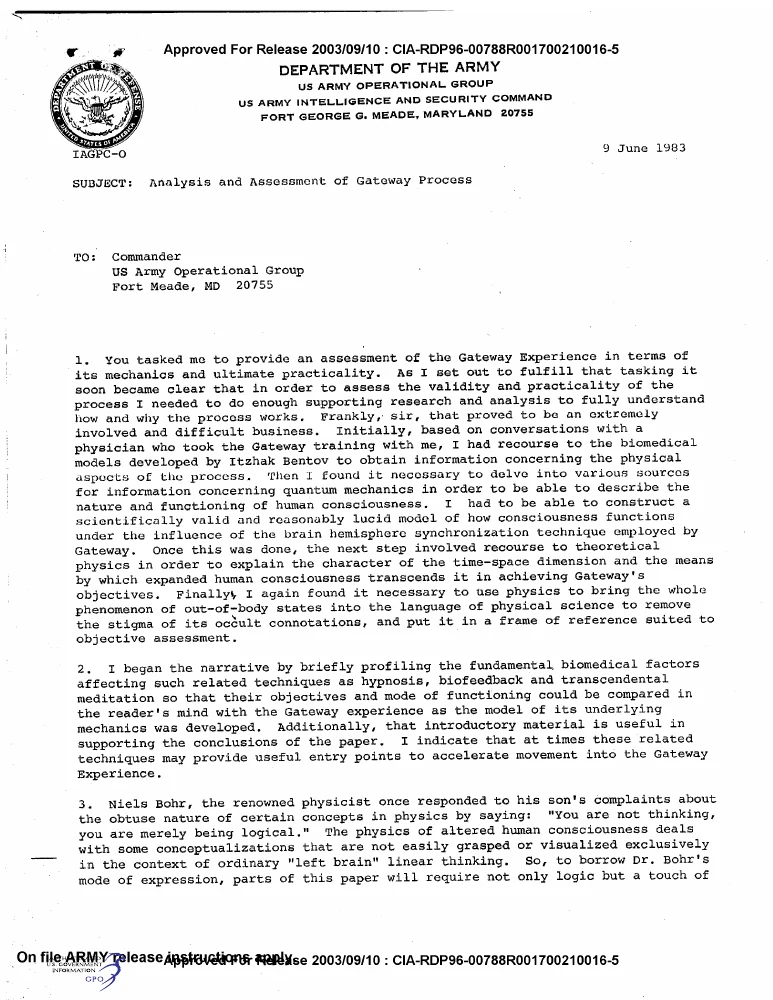
Choose a passage above. The explanations are ONLI commentary; the source image is unchanged.
Sources & further reading
ONLI’s guide is separate from the linked authors’ work. Links checked 24 October 2026.
A finding becomes more informative when it can be challenged.
Fix the question, target-selection method, information controls, scoring, sample plan, and stopping rule. Describe any change before interpreting the comparison.
Retain misses, withdrawals, unfinished trials, and protocol deviations under the stated inclusion rules. Explain exclusions rather than quietly removing inconvenient records.
A second run by the same team is useful but does not provide the same check as a study conducted independently with its own target handling and judging.
A low score can reflect ordinary variation, a weak design, or a claim that did not hold under the tested conditions. State what the data can distinguish and where the study remains inconclusive.
Show the original result and the attempted replication together. Preserve differences in procedure and uncertainty. Do not pool unlike tasks merely to obtain a more favorable total.
Read the program through its records.
Declassified records gathered from CIA, DIA, and the U.S. Army document government investigations of remote viewing. CIA’s published historical account describes the collection and the decision not to restore the program after the 1995 review.
The collection places research, procedures, and assessments in their historical context. For each item, identify the authoring organization and document type; custody in a CIA archive does not make every item a CIA-authored finding.
Source access
CIA history published 27 October 2021. The Reading Room catalog redirected to a maintenance notice when checked on 24 October 2026. The historical overview was accessible.
Analysis and Assessment of Gateway Process
An Army memorandum examining the Gateway Experience and proposing an explanation for its approach to altered states of consciousness. It is a historical assessment, not a controlled demonstration of the claims it discusses.
It shows how one military office framed a proposed consciousness-training method. Read the author’s explanations and recommendations as the document’s position, distinct from established experimental findings.
Original document
Cover preview rendered from the preserved government scan. Source document and catalog record checked 24 October 2026.
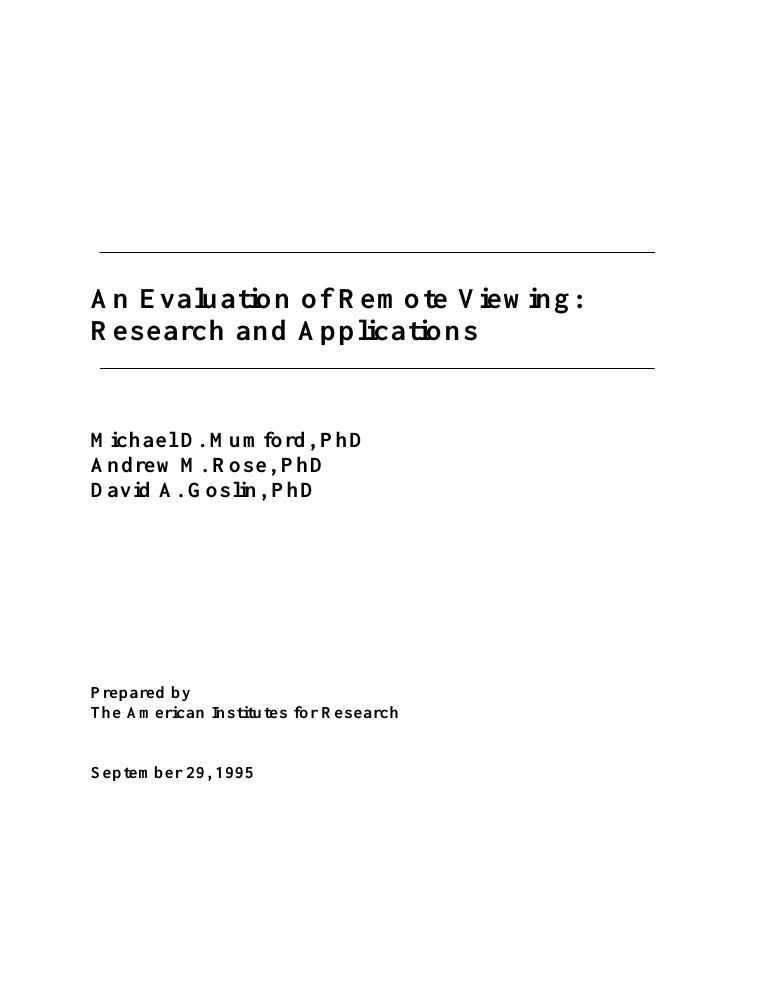
An Evaluation of Remote Viewing: Research and Applications
A review of laboratory research and intelligence applications. It includes differing expert interpretations of the laboratory evidence and an assessment of operational usefulness.
The evaluation reported above-chance laboratory results but did not establish a paranormal cause. It found the operational material too vague and inconsistent for actionable intelligence and recommended against continued intelligence use.
Read the expert reviews alongside the executive summary and operational assessment. The distinction between a laboratory finding, its explanation, and practical reliability is central to evaluating the record.
Original report / Preserved copy
Read source document ↗The report is preserved by a university archive. Its authorship remains AIR; it is separate from ONLI’s commentary. Source copy checked 24 October 2026.
A procedure is part of the evidence.
NASA’s catalog identifies Puthoff and Targ’s published paper on experiments with geographical and technical targets at Stanford Research Institute. The catalog provides bibliographic information and an abstract, but currently no full-paper download. NASA’s hosting of the record is separate from authorship.
AIR’s review describes responses compared with targets and decoys, including photographic targets and judge rankings. Read the procedure alongside the review’s methodological concerns.
For each historical procedure, ask: Who selected the target? What could the participant and facilitator know? When was the response fixed? Who judged it? How were all trials retained?
A geographic field task, a photograph-ranking study, and ONLI’s current self-matching task are different designs. Preserve those distinctions when discussing results.
Sources & further reading
ONLI’s guide is separate from the linked authors’ work. Links checked 24 October 2026.
Selected milestones in research, review, and analytic practice.
This is a sourced reading route, not a complete program history or a claim of institutional continuity with ONLI.
CIA’s historical account dates the start of its own psychic-phenomena research to the summer of 1972.
Source record ↗Puthoff and Targ’s paper appears in March. NASA’s record identifies its authors, journal publication, and research setting.
Source record ↗CIA’s retrospective account records the end of its own research program in 1977.
Source record ↗The memorandum is dated 9 June. Its later release marking is a separate date.
Source record ↗The report dated 29 September examines research and operational applications and argues against continued intelligence use.
Source record ↗Heuer’s Psychology of Intelligence Analysis is published, addressing perception, memory, judgment, and bias.
Source record ↗The March Tradecraft Primer presents approaches for challenging judgments and managing uncertainty.
Source record ↗Dates refer to the event or publication described. Source custody, release history, and later uploads remain separate. Links checked 24 October 2026.